by Keren Moscovitch
As a doctoral candidate in Philosophy, Art Theory and Aesthetics, I have been introduced to a dual approach of intertextual and topological analysis which has given me a new perspective of plurality and infinity of interpretation.
Intertextual analysis is the relating of multiple texts (writings, artworks) to one another to form a nonchronological dialogue between people and their ideas. In identifying the threads that run through multiple authors’ works, one idea builds off of another, offering new thoughts to engage the first idea and creating new thoughts and relationships that would not have existed outside of the dialogue. Intertextual analysis disrupts the established linear, chronological narrative that is so often dominated by whomever is in charge at the time. We realize that the meaning of a text is infinite, because it has as many meanings as the infinite combinations of people reading it and relating it to an infinite number of other texts. We discover that we can only know a thing in relation to another thing.
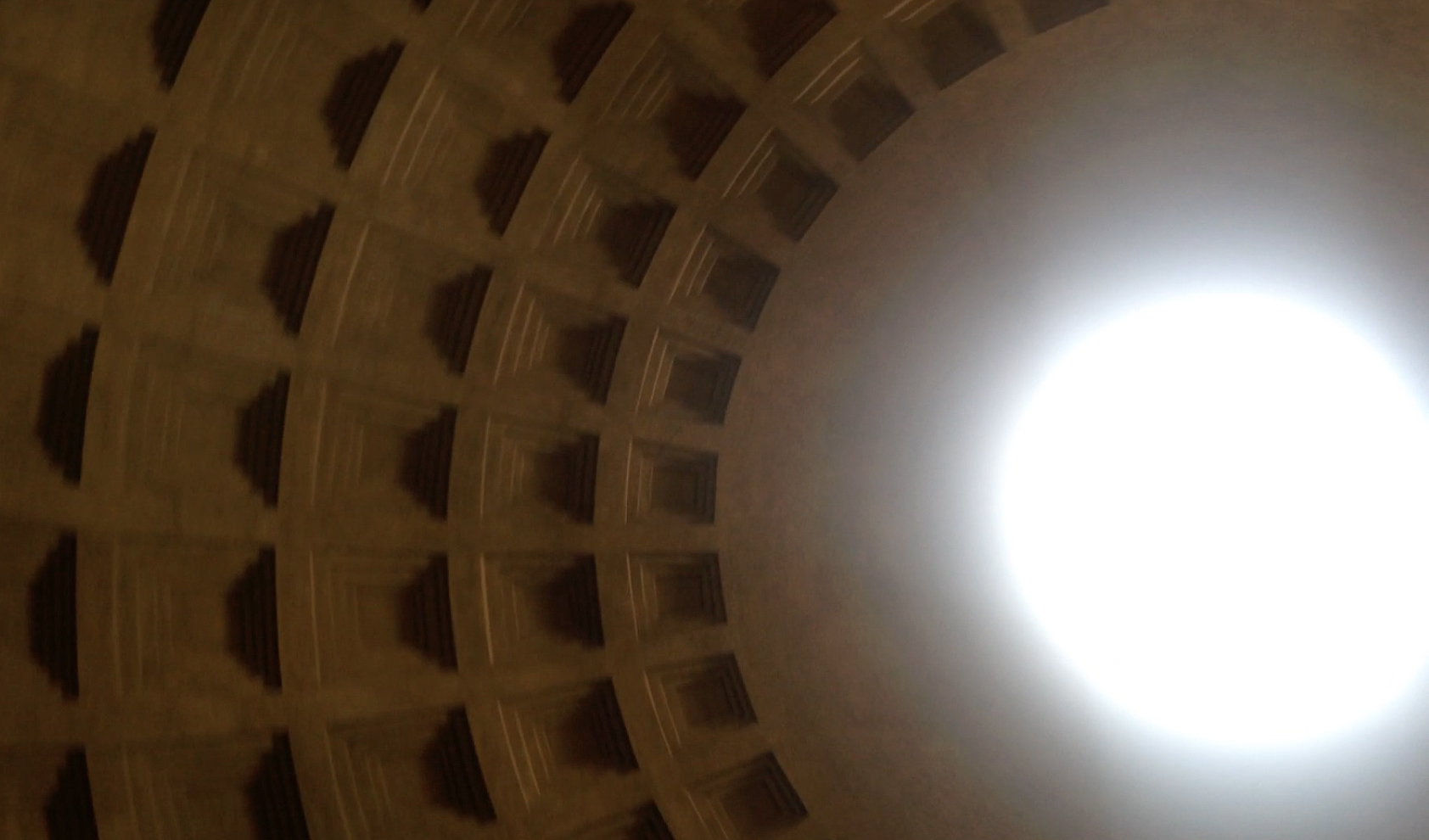
One example comes to mind of a recent experience inside the Pantheon in Rome. Looking up at the grandeur of this magnificent structure, through the portal in the dome leading up to the sky, my breath was momentarily taken away. I asked my colleagues if anyone knew the purpose of the big hole? Someone explained the architecture and engineering of such a structure, and that the builders were able to expand the size of the dome by removing some weight from the structure. However, it was clear to me that the hole functioned as something more, that it was a portal to the Heavens, a direct line to the Divine. The clarity was intuitive, visceral… it came from not only my own experience of spirituality, but also artworks that came to mind the moment I walked in.
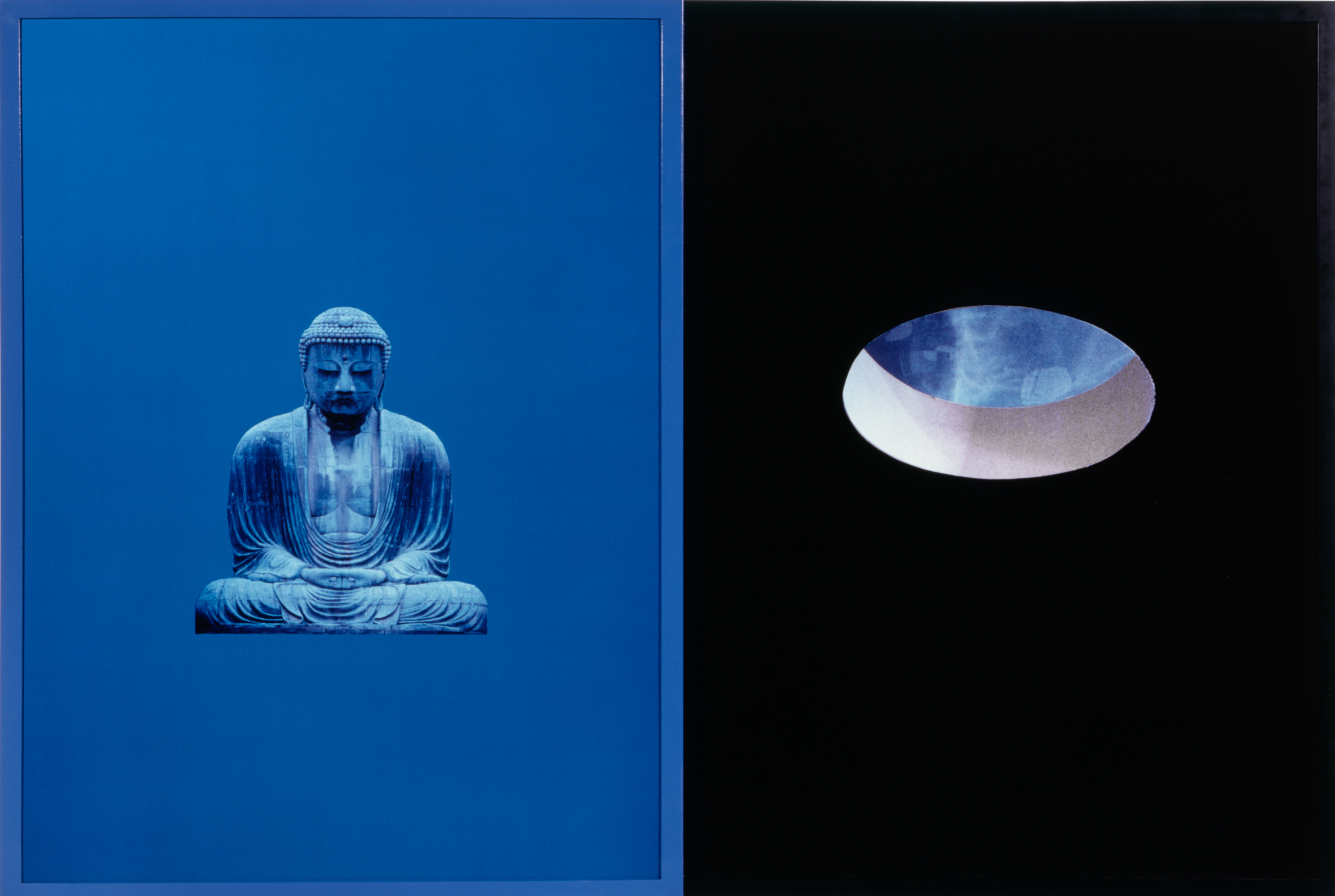
I thought of Sarah Charlesworth’s Buddha of Immeasurable Light, a diptych that on the left shows a Buddha statue floating on a deep blue background, and on the right a ceiling surface punctuated by a cut-out hole leading through to a perfectly crisp view of a blue sky. I have known this image for a long time. Sarah was a mentor of mine in graduate school and I always struggled to understand her work. She was a true artist-philosopher, and her densely theoretical discussions of her own work always intimidated me. When I walked into this temple, and immediately felt in my gut that I was entering a sacred space – much more sacred than any of the other Churches and Cathedrals that I had visited during my time in Rome – both the piece and Sarah shone with new understanding. I had always interpreted the work as a critical commentary on spirituality and the ways that human beings use objects to connect us to the Divine – which it is. However, it was only in that moment that I understood that Sarah was not a detached intellectual, but had likely had experiences of transcendence and connection to some kind of divine energy and was honoring that experience through her work.
In her 1919 text From Ritual to Romance, Jessie Weston opens up a new reading of the Grail Legend. By inquiring as to the origin of the narrative, she shows us that the Christian story that has been the status quo for two thousand years is only the latest chapter of a much longer chronology of ideas, beliefs and rituals. I asked my colleagues what they thought was here prior to the building of the Temple, and was told that it was “just swamp land.” While I do not claim to be an expert, nor am I attempting to fabricate fantasies based on my own creative stirrings, or pretend that I know more than someone who probably does know more than I do about the history of Rome, I boldly asserted to my group that it is clear to me that prior to the Pantheon being built there was something else here. Not just a swamp or a cow pasture, but something sacred and divine that would be the reason for the Ancients building THIS shrine on THIS spot in THIS manner.
As a final point of intertextuality, I thought of a series of History Channel and National Geographic documentaries about Ancient Egypt, Stonehenge and other prehistoric and ancient sacred sites, that I had recently been hungrily consuming. I heard all kinds of theories about celestial constellations, planetary alignments, sun worship and even extraterrestrials. Some of the theories were farfetched, while others were established “fact” but all pointed me in one direction when I walked into the Pantheon – Up. I believe that if we dug beneath the layers of the structure as it stands today, if we had the right tools and technologies, if items of interest stood the test of time, or if we had a time machine, we would find that on this spot, prior to the Ancients, something else happened. A ritual, a realization, a celestial observation, a miracle… A thought. I am of the opinion that something must have happened here to make THIS thing happen here.
Topological Analysis is the observation of multiple layers of time and place, examining cultural patterns the way that a geologist may study the layering of different sediments and draw conclusions about what happened at various points in history. By the time I reached the Pantheon, I had spent four days in Rome observing the layering of Modern on top of Christian on top of Roman architecture – an accumulation of culture, thought and belief. It was only through this experience that I was able to – and in fact compelled to – formulate my questions about what was beneath the structures we see today that every tour guide so far has referred to as the original structures (the original Roman road, the original wall, etc.).
As we dig through layers of sediment, both physical and mental, it becomes very difficult to discern what came before what, to establish causality and to assign authorship. We are all the authors of the texts that we read, and time comes back to reassert itself outside of the established chronology. We may choose to see each text that we consume as a series of geological locations, into which we may dig to find narratives hidden between the lines, or those that would be understood only in relationship to what came before, after and concurrent to.
Keren Moscovitch is a lens-based artist who explores intimacy and the ways in which the sexual and the spiritual intersect. She regularly collaborates with other artists to dissect the ways in which relationships are built, and identity is formed. She lives and works in New York City where she teaches at the School of Visual Arts. Her monograph Me Into You was published in the summer of 2012, featuring 35 images and an essay by Allen Frame. She is obsessed with people’s secrets, especially the ones that take place in the bedroom.

