The Ideology of the Secret City

by Keren Moscovitch

What is Pure Form? In aesthetic/Greenbergian terms it is the material with which one is working and the physical shape of a work of art. It is the color and structure of a shape, the length and thickness of a line, the overall composition of a canvas. It is material speaking as material, substance that is only defined by its own physical properties. As ideology, it represents Louis Althusser’s concept of the imaginary relationship of individuals – the belief that form deprived of content connects humans to a higher state of being – to their real conditions of existence – their earthly reality. For Plato, Pure Form is of divine provenance. As humans, we will never have access to it because we only have access to the terrestrial world – the Cave. The goals of Plato’s Republic are to create a utopian society that functions efficiently and effectively, and the ones that guard it – the philosophers – are the ones that are most connected to Pure Form.

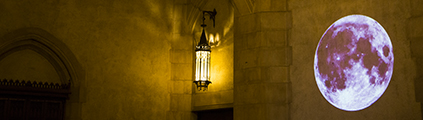
A recent exhibition that beautifully illustrated this concept was Secret City by Ilya and Emilia Kabakov, installed at the Grand Palais in Paris. This body of work explores the power of Pure Form as it exists on both of these levels – physical and ethereal – and provides viewers with an experience of transcendence, humility and a deep grounding in what it means to be human.

When I first walked into the massive space of the Grand Palais, the first thing I noticed was the beautiful peaceful music coursing through my body. The music seemed to fill every crevice of the space and followed me wherever I went. I thought about music as it relates to the modernist concept of form as divorced from narrative, and allowed it to move me through the purity of its being. I am personally not a formalist, as I believe that content is inherent in everything, but the abstraction of music transmits a spiritual sensation that transcends time, space and, I must admit, Content. Meandering through the space, I discovered that the music was emerging from a huge conical speaker at the far end of the Palais. A giant shape punctuating, ruling and dominating the structure of the Secret City, as if it was the divine force that was fueling the whole thing. Pure geometric form leads the citizens of the Utopian city into connection with higher powers within themselves and the Universe at large.

IMG_1740

As form, this body of work is a map and guidebook through the process of creating the Secret City. The exhibition is presented as a set of instructions and therein exists its discourse. If humanity follows a certain formula, arrived at via the wisdom of spiritual leaders and seekers throughout the ages and leading up to the ideal solution, society will achieve spiritual salvation. On an experiential level, the content at a certain point becomes irrelevant as the shape of the city itself wraps itself around the visitor and guides him/her through the space.

The artists, however, only use form to begin the conversation, and build an infrastructure for the exploration of their Utopian narrative. Though the architecture of the exhibition is geometric and somewhat abstract, it holds within its shell a detailed written description of the Utopian city, designed to harness creativity, ideas and cosmic (Divine?) energy. As ideology, the content of this work is a manifesto. It is a declaration of intention and behavior of the designers and citizens of the Secret City. As Russians who lived through the Stalinism and the Cold War, the Kabakovs understand what it means to live in a repressive society in which freedom is elusive. Their manifesto for the secret city represents an ambivalent relationship to authority, power and religion. The questions posed in the piece reveal the Kabakovs’ history in the USSR and represent pure content as ideological inquiry.

Overall, I found this installation to be incredibly moving, complex and transcendent. I have yet to decode many of its messages and look forward to coming back to it again and again and as I learn the philosophical ideas that serve as its foundation.

In closing, forms on their own do not in themselves function as ideology. It is the belief in the power of these forms, in their primacy, that constructs the ideology that can build – or destroy – civilizations. Plato feared artists and poets due to their departure from form and immersion in content – specifically, the content of passion and emotions. It is this belief – this ideology – that built the imaginary realm of the Republic. Secret City takes Plato’s narrative and twists it into something truly Utopian – a society in which all members are interconnected – to each other, to the Earth and to the Cosmos.

Keren Moscovitch is a lens-based artist who explores intimacy and the ways in which the sexual and the spiritual intersect. She regularly collaborates with other artists to dissect the ways in which relationships are built, and identity is formed. She lives and works in New York City where she teaches at the School of Visual Arts. Her monograph Me Into You was published in the summer of 2012, featuring 35 images and an essay by Allen Frame. She is obsessed with people’s secrets, especially the ones that take place in the bedroom.
Standard

Immeasurable Lightness of Being

by Keren Moscovitch

As a doctoral candidate in Philosophy, Art Theory and Aesthetics, I have been introduced to  a dual approach of intertextual and topological analysis which has given me a new perspective of plurality and infinity of interpretation.

Intertextual analysis is the relating of multiple texts (writings, artworks) to one another to form a nonchronological dialogue between people and their ideas. In identifying the threads that run through multiple authors’ works, one idea builds off of another, offering new thoughts to engage the first idea and creating new thoughts and relationships that would not have existed outside of the dialogue. Intertextual analysis disrupts the established linear, chronological narrative that is so often dominated by whomever is in charge at the time. We realize that the meaning of a text is infinite, because it has as many meanings as the infinite combinations of people reading it and relating it to an infinite number of other texts. We discover that we can only know a thing in relation to another thing.

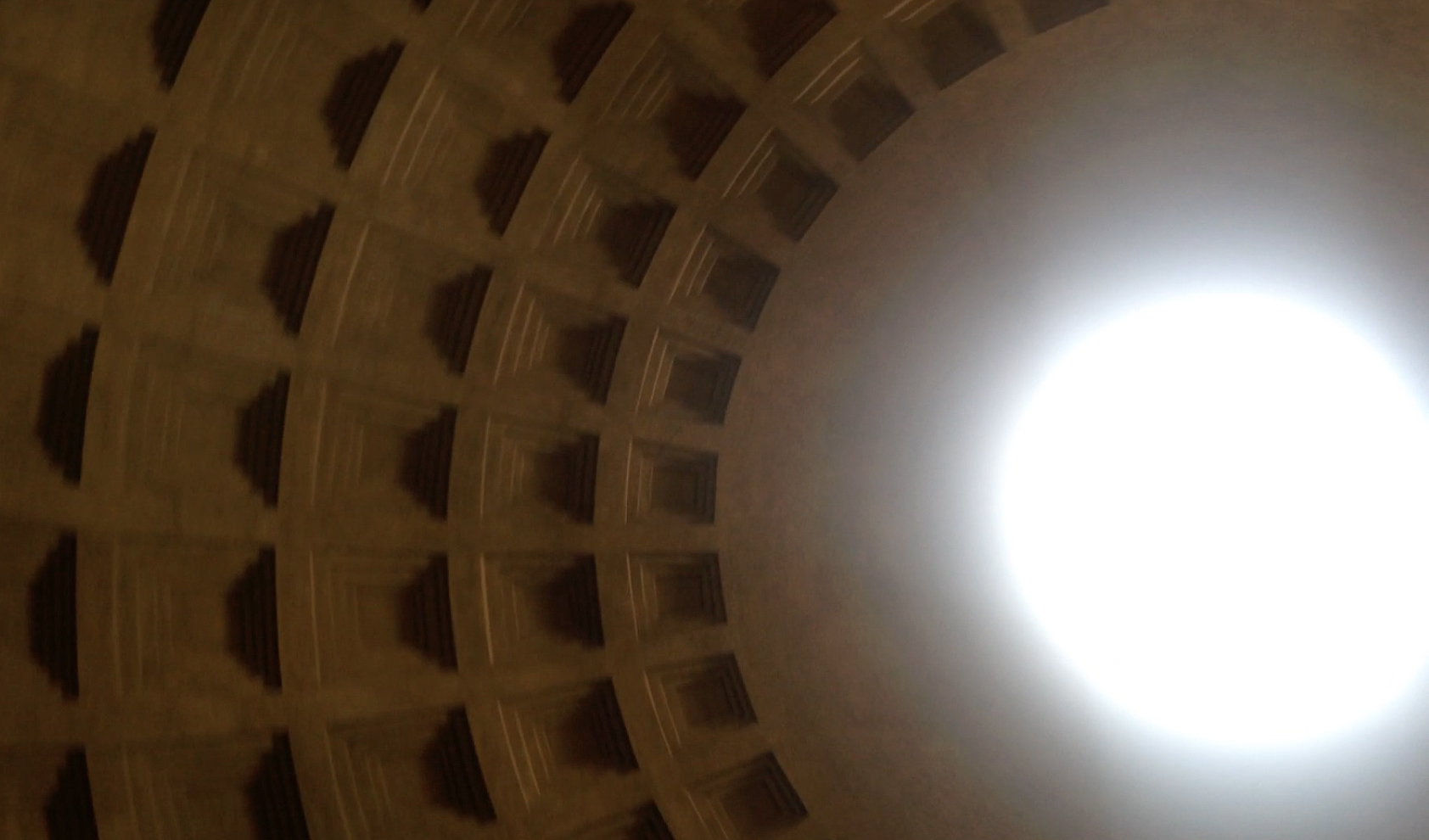
One example comes to mind of a recent experience inside the Pantheon in Rome. Looking up at the grandeur of this magnificent structure, through the portal in the dome leading up to the sky, my breath was momentarily taken away. I asked my colleagues if anyone knew the purpose of the big hole? Someone explained the architecture and engineering of such a structure, and that the builders were able to expand the size of the dome by removing some weight from the structure. However, it was clear to me that the hole functioned as something more, that it was a portal to the Heavens, a direct line to the Divine. The clarity was intuitive, visceral… it came from not only my own experience of spirituality, but also artworks that came to mind the moment I walked in.

pantheon

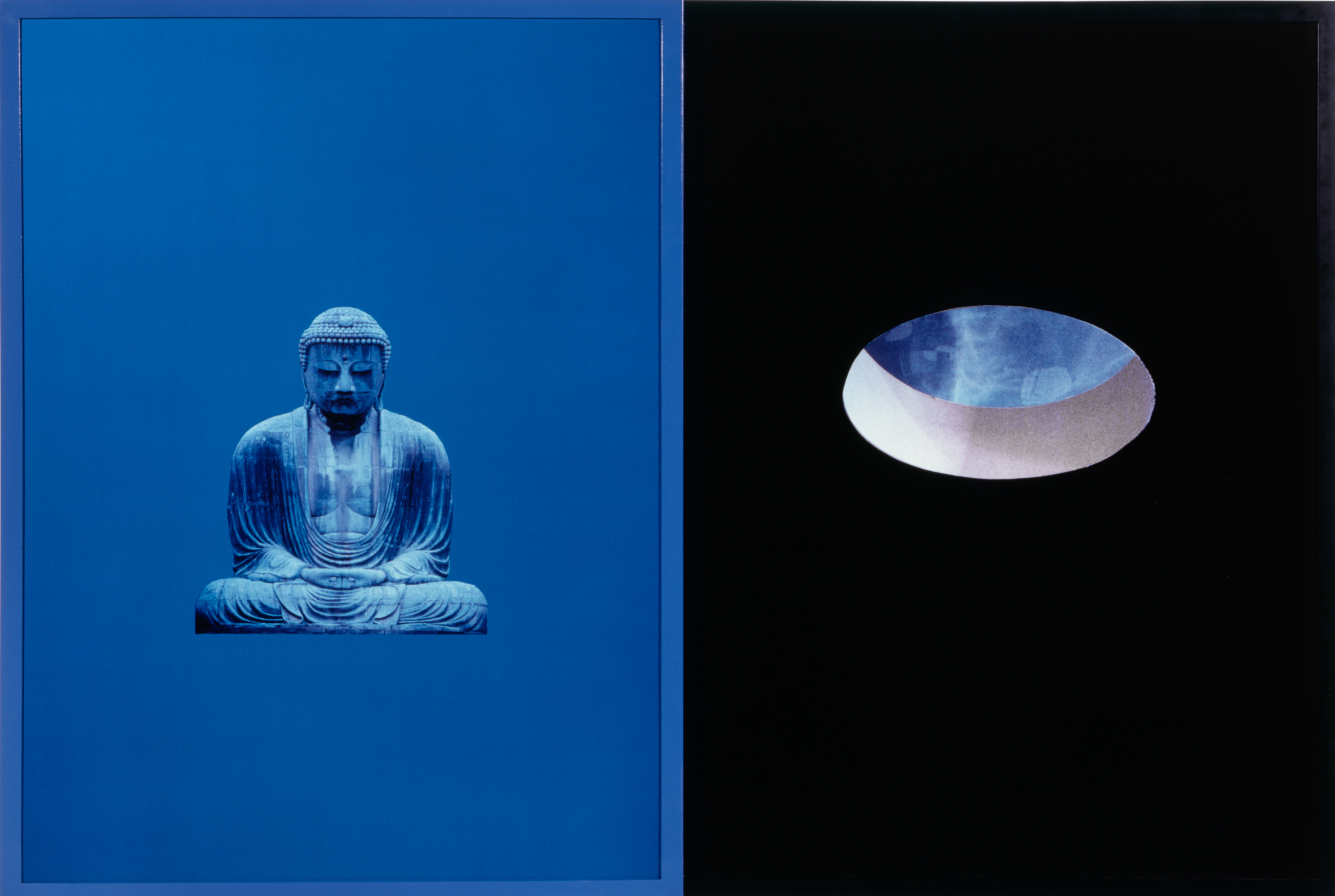
I thought of Sarah Charlesworth’s Buddha of Immeasurable Light, a diptych that on the left shows a Buddha statue floating on a deep blue background, and on the right a ceiling surface punctuated by a cut-out hole leading through to a perfectly crisp view of a blue sky. I have known this image for a long time. Sarah was a mentor of mine in graduate school and I always struggled to understand her work. She was a true artist-philosopher, and her densely theoretical discussions of her own work always intimidated me. When I walked into this temple, and immediately felt in my gut that I was entering a sacred space – much more sacred than any of the other Churches and Cathedrals that I had visited during my time in Rome – both the piece and Sarah shone with new understanding. I had always interpreted the work as a critical commentary on spirituality and the ways that human beings use objects to connect us to the Divine – which it is. However, it was only in that moment that I understood that Sarah was not a detached intellectual, but had likely had experiences of transcendence and connection to some kind of divine energy and was honoring that experience through her work.

BuddaofImmeasurableLight-copy

In her 1919 text From Ritual to Romance, Jessie Weston opens up a new reading of the Grail Legend. By inquiring as to the origin of the narrative, she shows us that the Christian story that has been the status quo for two thousand years is only the latest chapter of a much longer chronology of ideas, beliefs and rituals. I asked my colleagues what they thought was here prior to the building of the Temple, and was told that it was “just swamp land.” While I do not claim to be an expert, nor am I attempting to fabricate fantasies based on my own creative stirrings, or pretend that I know more than someone who probably does know more than I do about the history of Rome, I boldly asserted to my group that it is clear to me that prior to the Pantheon being built there was something else here. Not just a swamp or a cow pasture, but something sacred and divine that would be the reason for the Ancients building THIS shrine on THIS spot in THIS manner.

As a final point of intertextuality, I thought of a series of History Channel and National Geographic documentaries about Ancient Egypt, Stonehenge and other prehistoric and ancient sacred sites, that I had recently been hungrily consuming. I heard all kinds of theories about celestial constellations, planetary alignments, sun worship and even extraterrestrials. Some of the theories were farfetched, while others were established “fact” but all pointed me in one direction when I walked into the Pantheon – Up. I believe that if we dug beneath the layers of the structure as it stands today, if we had the right tools and technologies, if items of interest stood the test of time, or if we had a time machine, we would find that on this spot, prior to the Ancients, something else happened. A ritual, a realization, a celestial observation, a miracle… A thought. I am of the opinion that something must have happened here to make THIS thing happen here.

Topological Analysis is the observation of multiple layers of time and place, examining cultural patterns the way that a geologist may study the layering of different sediments and draw conclusions about what happened at various points in history. By the time I reached the Pantheon, I had spent four days in Rome observing the layering of Modern on top of Christian on top of Roman architecture – an accumulation of culture, thought and belief. It was only through this experience that I was able to – and in fact compelled to – formulate my questions about what was beneath the structures we see today that every tour guide so far has referred to as the original structures (the original Roman road, the original wall, etc.).

As we dig through layers of sediment, both physical and mental, it becomes very difficult to discern what came before what, to establish causality and to assign authorship. We are all the authors of the texts that we read, and time comes back to reassert itself outside of the established chronology. We may choose to see each text that we consume as a series of geological locations, into which we may dig to find narratives hidden between the lines, or those that would be understood only in relationship to what came before, after and concurrent to.

Keren Moscovitch is a lens-based artist who explores intimacy and the ways in which the sexual and the spiritual intersect. She regularly collaborates with other artists to dissect the ways in which relationships are built, and identity is formed. She lives and works in New York City where she teaches at the School of Visual Arts. Her monograph Me Into You was published in the summer of 2012, featuring 35 images and an essay by Allen Frame. She is obsessed with people’s secrets, especially the ones that take place in the bedroom.

Standard

Substance and Spirituality

Dali_Galateaofspheres


by Taliesin Thomas

Existence is realized somewhere between continuity and discontinuity, between the actual and the imagined. This paradox is integral to our human paradigm; on the one hand the elements of this life are corporeal and impartial—we can, quite literally, grasp the material nature of objective reality. On the other hand these same forces are hypothetical and subjective; all causes are relative and theoretically contingent on other conditions—there can be no independent “thing-in-itself” (das Ding-an-sich) separate from the totality of being. Nothing exists in concrete terms; everything abides in a state of continual flux. What, if anything, is actually something?

Philosophers from ancient to contemporary times point to ‘substance’ as a foundation for presence. Long ago, Parmenides considered all phenomenon as one substance, that of Nature or God, while centuries later Kant identified substances by virtue of their differentiation from a singular essence: “we yet cannot take away that property through which the object is thought as substance or as inhering in a substance.” More recently Deleuze and Guattari suggest substance is formed as matter that refers to “territorialities and degrees of territorialization and deterritorialization.” Thus throughout the ages substance functions as its own form of implied realism: actual things are ordered by and dependent on substance, a primary instance of being.

How do varying categories of substance serve as principles that create our concept of selfhood and real existence? Does substance manifest as a reliable infrastructure by which we might discern between the somatic and the supernatural? Arguably it does not—substance is mere a deception of language and a delusion of metaphysical inquiry. The improbability of ordering our world via substance is that, as furthered by Leibniz, this “mirroring” of monads into physical realities suggests: “the universe may be merely a dream.” Although we incarnate in bodily form, our perceptible world cannot be characterized as an explicit actuality in permanent objective terms.

Substance remains a versatile and enigmatic phantom of philosophy—our alleged reality is a distinctly protean construction that exists somewhere between the molar and the molecular. Within this elusive void we experience our existence qua substance. While thinkers from time immemorial have done a considerable job of analyzing this essential term, substance remains an imaginative handmaiden for the boundless abstract that philosophers reify with astute reasoning but ultimately fail to represent in definitive terms. Substance is indeterminate: the delusive search for something consistently results in nothing.

Reality is not stable, despite its convincing identity in carnal terms—proof of this illusion is illustrated in a stunning example of modern art by Salvador Dalí (1904 – 1989): “Galatea of the Spheres” (1952). This painting presents the viewer with an interpretation of substance that is both visual and textual. While the surrealist style of the portrait affords a visionary encounter with the atomic nature of substance, the underlying psychoanalytic implication of the work suggests a philosophical interpretation of our inherent vacuity. As demonstrated by the hallucinatory nature of substance revealed through this masterful work of art, progressive identification with substance as a root of metaphysical conception lacks conclusive definition. Dalí’s “Galatea of the Spheres” beautifully exhibits a philosophical perspective of substance in visual terms, and suggests that our definition of substance reveals the delusive search for nothing as something.

These days humanity appears to be living an increasingly bi-polar existence, one caught between the corporeal and immaterial spheres of influence. While contemporary culture is dominated by the sweeping impacts of globalization, the ambiguity of the spaces “in-between” propel us to reconsider the foundations of existence. The performance of modern living—in all its diverse representations of substance—allows formlessness to speak through form, where the monads of life embody the ambiguities of that very existence. Although we exist as finite matter and inevitably dissolve into some other form of matter, ultimately we cannot define ourselves through that substance. Our being-as-substance remains a mystery, and ultimately “man is reduced to a sequence of unrelated experiential fragments; he is as inexplicable to others as to himself” (Lukács).

If we agree that philosophy has no shallow end, then terms such as ‘being,’ ‘essence’ and ‘substance’ buoy our ramble into the deep metaphysical abyss. Arguably we are adrift without these lifelines of conceptual language to orient the dialogue concerning existence. These ideas, however, are used in various ways and with different meanings, depending on the thinker—their implications are reordered and deciphered by the receiving mind. Indeed, the very words that comprise the basis of philosophical analysis are often multifaceted and enigmatic. Our attempt to concretize these definitions leads to a metaphorical “house of mirrors” as it concerns interpretation and our understanding of things: everywhere we turn, we encounter a dualistic paradigm, a re-contextualization and reinterpretation of rationale. If we introduce the notion of ‘science’ as a subject distinct from philosophy into this analysis, the paradox becomes even more phantasmagorical.

Like many foundational philosophical ideas, the varying explanations of substance chaperone man’s intellect toward greater intuition. The seemingly solid nature of substance qua substance, however, does not provide a definitive understanding of our material incarnation. On the contrary: the manifold definitions of substance yield a rich exoteric language that merely masquerades the esoteric chasm of existence. Dalí’s “Galatea of the Spheres” speaks directly to this paradigm: it is only our realization of the “substance-lessness” quality of being within the void—and conversely the void within our being—that results in true autonomy for the subjective mind.

Taliesin Thomas received her BA in Fine Arts from Bennington College (’98) and completed her MA in East Asian Studies from Columbia University (’12) with a focus on Chinese art and culture and Buddhist studies. She is currently a PhD candidate in Art Theory and Philosophy with the Institute for Doctoral Studies in the Visual Arts. Thomas has worked in the field of Chinese contemporary art since 2001, first as the managing director of Ethan Cohen Fine Arts (the oldest gallery in the United States to specialize in Chinese avant-garde art) and then as a lecturer and private teacher on the subject. In 2007 she was hired as the founding director of AW Asia, a private organization that exclusively promotes the field of Chinese contemporary art.

Standard

A Golden Calf, Contemporary Art, and the Cult of the Material: Idol Worship in the 21st century

by Nik Nejad

Ever considered yourself to be an idol worshiper? In the context of this discussion you might. To disambiguate the term “idol” first, let’s use an example. Looking back at Abrahamic religions, we know that idol worship is VERY BAD. In the Hebrew Bible there is a quintessential anti-idolatry narrative of the Golden Calf; (here’s the Coles Notes version)

Moses was on Mt Sinai being the savior of mankind and receiving the Ten Commandments, while the Israelites lose certainty of his return and begin to worship a Golden Calf. Moses then returned and made a whole bunch of people kill another whole bunch of people as punishment for worshipping the Golden Calf. What they were supposed to do was have faith in the creator, not the Calf. But that didn’t happen. *Sigh

I totally understand why the Israelites decided to do as they did; the Golden Calf was real, they could SEE IT. Most of humanity in today’s world does the same on a daily basis (except for the token shaman and sage here and there). If you can see it, touch it, smell it, feel it, or hear it, then it is real. Everything that we have ever experienced has come through the conduit of the senses. The creator that Moses talked about, well, they couldn’t even find him on Instagram.

We are by nature, slaves to our five senses. So it’s not a surprise that the physical world trumps all the other wishy-washy stuff. But first lets understand exactly how meager the realm of the senses really is. (The term meager is generous to say the least). Consider this: Our eyes can only pick up on a fraction of wavelengths out there, but we know that infrared exists, we know that x-rays and radio waves exist too, though we cannot directly sense them. The same goes for hearing and all of the other senses. All together they can only capture a minuscule fraction of ‘what is really going on’. There is a massive spectrum of vibration and frequency beyond that which we can access. Relatively speaking, we are quite blind.

But how else are we supposed to experience the world if not through our 5 senses? That, my friend, is where spirituality kicks in. The big paradox. It asks for us to not only go beyond our senses, but also rational thought. ‘Even the conscious mind, and your several layers of ego, can be preventing you from connecting to the light.’ For generation Y this might be more than hard to swallow, surely more difficult to swallow than a can of Coke Zero.

You want something real? How about the look of your recently lifted face, that new car smell, the sound of people praising you, and the feel of that new Fendi handbag. This is idol worship in the 21st century. In the Mosaic times they had the Calf, today we have the Kardashians, both representations of our bond to the material. Enlightenment Shenlightenment! Unless it’s in fashion,

“Being Zen is the new black, didn’t you know?”

We are obviously going down some kind of road, and our pace is picking up. The world is getting smaller, things are moving faster and faster. According to Ray Kurzweil, genius inventor extraordinaire, we are moving toward a point, “the singularity,” beyond which it is hard for our yet-to-be synthetically-enhanced, brains to understand. What effect does hyper-materialism have in the future? Some would argue that, in today’s world, the mass-commoditization of culture has in effect led to its degradation. For example, earlier this month, Mark Simpson, who coined the term ‘metrosexual’ proclaimed, “The metrosexual is dead. Long live the spornosexual.” What is a spornosexual? As Simpson puts it: “where sport got into bed with porn, while Mr. Armani took pictures.” It describes how men want to be wanted for their bodies, not for their whit, charm, clothing and especially not for their deep substance. His article not only exemplifies increasing obsession towards the physical, but is also a rather ironic example of how common lexicon is changing with the times. We are seeing language cut down into effective little packets, delivering information more economically. It’s all rather funny, I mean LMAO.

What about art? From its inception, art was a highly spiritualized tool. Think cave paintings, to ancient Greek sculpture to Caspar David Friedrich. Now spirituality is close to completely absent in contemporary art. Hirst may very well introduce concepts around spirituality and religion, but it ends up being a commentary rather than a real connection. It also helps that Hirst has become a very powerful brand.

“Spirituality, yes! A great idea! Sounds like it can make some serious bucks.”

I consider myself to be a spiritual artist, which is becoming more and more of an oxymoron as time goes on. Thus I beg to ask: ‘Is there room for spirituality in contemporary art?’ Is its relative absence due to socio-economics, wherein artists are simply suppliers meeting a demand in a capital market? Or have the artists themselves lost touch with spirituality and also fallen to the cult of the material? The answer will likely be a mucky shade of grey rather than black and white. It is nevertheless important to continue questioning the purpose of art, especially considering the potential art has to transform culture rather than simply be the by-product of it.

Unfortunately, we don’t have any precedent to see if we are going down the wrong road or not. Globalization, cloud computing, robotics and genomics are game changers in this new world, call it ‘Post-Singularity’ or the ‘Age of Aquarius’. The purpose of this blurb is not to criticize, though some of the rhetoric is intentionally Perezian. All I am saying is ‘lets just keep our selves in check’, so at least we don’t walk down this road with a blindfold on our eyes fixed to our smartphones, and eventually fall off a cliff. Perhaps I just recommend a brief moment pause to ask, ‘how does spirituality fit in to this increasingly material obsessed culture?’ Are we still striving for truth? Are we conditioning the youth to be excellent consumers or to elevate themselves and society? Is the road we are on bringing light or darkness? Will we be the Israelites worshiping a Golden Calf or will we wait for Moses?

Nik Nejad was born in Toronto, Canada on October 23 1984. He is of Persian heritage and is currently based in New York city. Working mostly with painting and video, his work has addressed the association between spirituality and technology. A variety of international publications and media outlets have covered Nejad’s work including: Harpers Bazar, Time Out, Dubai TV, and Oasis Magazine. Nik Nejad has also been very active as a social entrepreneur. As a member of the British Council’s Cultural Leadership Initiative, he recently co-founded Alternational, a platform to expose the current cultural shifts taking place in the Middle East.

http://www.niknejad.net/

Standard